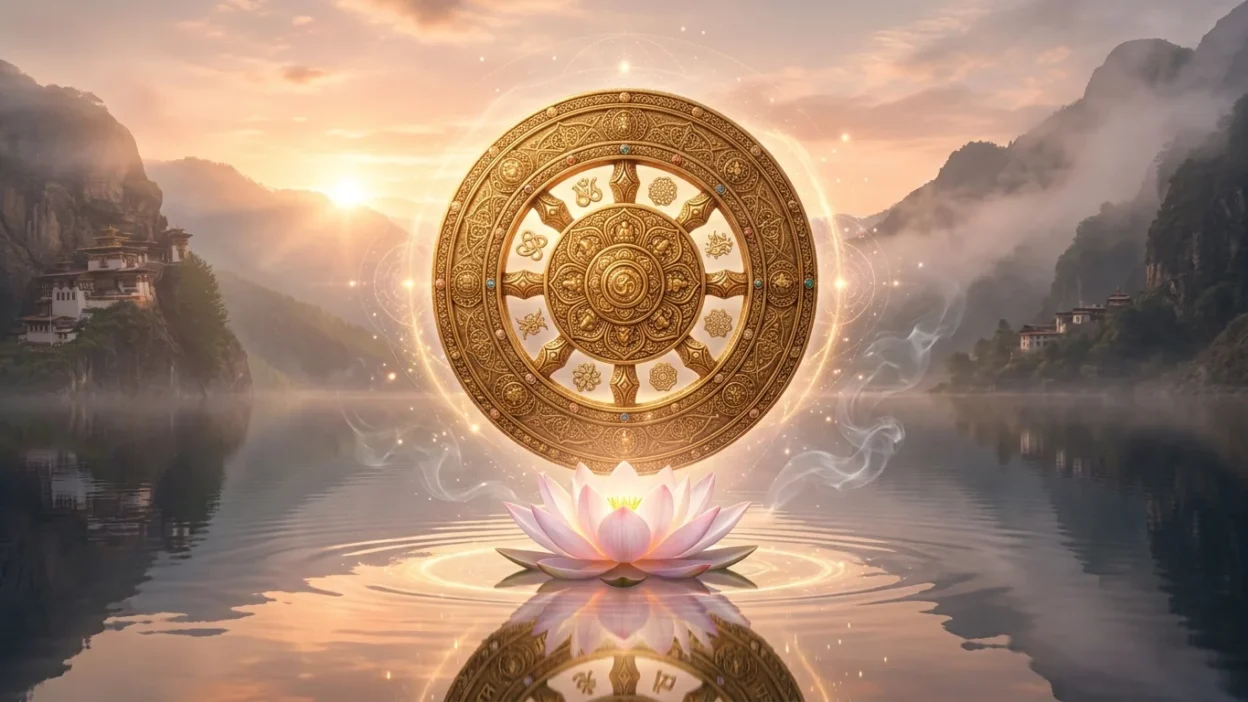
The karma wheel is a powerful symbol associated with cycles, cause and effect, spiritual growth, transformation, and the continuing journey of life. Often represented as a circular wheel, it reflects the idea that actions and intentions can create consequences while experiences can lead to learning and personal development.
The karma wheel symbolism has deep connections with Indian religious and philosophical traditions, particularly Buddhism, Hinduism, and Jainism, although the meaning and interpretation differ between traditions. Today, the symbol is also widely used in art, tattoos, jewelry, meditation, and spiritual imagery.
Karma Wheel Symbolism Meaning (Clear Definition)
Karma wheel symbolism represents the continuous cycles of actions, consequences, experiences, learning, and transformation.
The circular shape is especially important because a wheel has no clear beginning or ending. Symbolically, this can represent recurring patterns, the ongoing cycle of life, and the relationship between what we do and what follows from our actions.
The karma wheel may therefore symbolize:
- Cause and effect
- Life cycles
- Spiritual development
- Personal responsibility
- Transformation
- Balance
- Rebirth
- Liberation
What Does Karma Wheel Symbolism Represent?
The karma wheel can carry several interconnected meanings.
| Symbolic Meaning | What It Represents |
|---|---|
| Cause and Effect | Actions creating consequences |
| Cycles | The continuing movement of life |
| Transformation | Growth through experience |
| Responsibility | Awareness of one’s actions |
| Balance | The relationship between actions and outcomes |
| Rebirth | Continuing cycles of existence |
| Wisdom | Learning from experiences |
| Liberation | Moving beyond repetitive cycles |
The wheel can also symbolize the idea that life is constantly changing. Experiences may repeat until they are understood, transformed, or approached differently.
Spiritual Meaning of the Karma Wheel
Spiritually, the karma wheel can represent the journey toward greater awareness and freedom.
In Buddhist traditions, the wheel is closely associated with the cycle of samsara—the continuing cycle of birth, death, and rebirth—and with teachings about karma and liberation. The Dharmachakra, or Dharma wheel, has a related but distinct meaning, representing the Buddha’s teachings and the path of Dharma.
In Hindu traditions, karma is connected with action and its consequences within the broader cycle of samsara.
Jain traditions also place strong emphasis on karma, ethical conduct, and liberation.
Because these traditions differ, the karma wheel should not be treated as having one single universal interpretation.
Karma Wheel Symbolism in Buddhism
The wheel is particularly important in Buddhist symbolism.
The Bhavachakra, commonly called the Wheel of Life, is a visual representation of samsara. It illustrates the cycles of existence and the conditions that keep beings within those cycles.
The Dharmachakra, or Dharma wheel, is another major Buddhist symbol. Its spokes represent different aspects of Buddhist teaching and the path toward awakening.
Although both are wheels, they should not be treated as identical symbols. The Wheel of Life focuses on samsara and its cycles, while the Dharma wheel represents the Buddha’s teachings and the path toward liberation.
Biblical / Religious Meaning of the Karma Wheel
The karma wheel is not a biblical symbol and does not have a specific Christian meaning.
The concept of karma comes primarily from Indian religious and philosophical traditions. Some people may compare karma with broader religious ideas about moral consequences, but karma should not be considered equivalent to Christian teachings about sin, judgment, or divine providence.
Within traditions where karma is central, the wheel can symbolize ethical action, cycles of existence, spiritual development, and liberation.
Karma Wheel Symbolism in History and Culture
The wheel has been an important symbol across many cultures because its circular movement naturally suggests cycles and continuity.
Within Indian religious traditions, wheels have been used to represent cosmic order, ethical principles, spiritual teachings, and cycles of existence.
Buddhist art frequently incorporates wheels into temples, sculptures, paintings, manuscripts, and ceremonial objects.
Over time, karma wheel imagery became popular worldwide, particularly in spiritual artwork, tattoos, jewelry, meditation spaces, and modern symbolic design.
Karma Wheel Symbolism in Literature and Art
In literature and art, the karma wheel often represents recurring experiences, consequences, destiny, transformation, and the possibility of breaking destructive patterns.
A spinning wheel can symbolize life’s constant movement.
A broken wheel may represent the end of a cycle or liberation from repetitive patterns.
An illuminated wheel can symbolize spiritual awakening and greater understanding.
Artists may combine the wheel with lotus flowers, flames, stars, scales, or flowing lines to communicate different ideas about transformation and spiritual development.
Dream Meaning of Karma Wheel Symbolism
Dreaming about a karma wheel may symbolize recurring experiences, personal growth, unresolved patterns, or a desire to understand the consequences of your choices.
Seeing a spinning wheel may suggest that you feel caught in a repeating situation.
A wheel stopping may represent the end of a particular chapter or pattern.
A broken wheel may symbolize breaking free from something that has repeatedly affected you.
A glowing or peaceful wheel may represent spiritual awareness, acceptance, or a new understanding of an important life experience.
Dream symbolism is personal, so the emotions and circumstances surrounding the wheel are important when considering its meaning.
Modern Meaning of Karma Wheel Symbolism
Today, karma wheel symbolism is often associated with balance, personal responsibility, spiritual growth, and transformation.
People may choose karma wheel tattoos or jewelry to represent lessons learned from the past, the continuing cycle of life, or a commitment to becoming more conscious of their actions.
The symbol can also represent the belief that difficult experiences can become opportunities for learning rather than simply being viewed as punishment.
Its circular design makes it especially powerful as a reminder that life is constantly moving, changing, and teaching.
Frequently Asked Questions
What does the karma wheel symbolize?
The karma wheel symbolizes cycles, cause and effect, personal responsibility, transformation, spiritual growth, and the continuing journey of life.
What does the karma wheel mean spiritually?
Spiritually, it can represent the cycles of existence, learning through experience, ethical action, transformation, and the movement toward greater awareness or liberation.
Is the karma wheel a Buddhist symbol?
Related wheel symbols are important in Buddhism, but different Buddhist wheels have different meanings. The Bhavachakra represents the Wheel of Life and samsara, while the Dharmachakra represents the Buddha’s teachings.
What does a karma wheel tattoo symbolize?
A karma wheel tattoo can represent personal growth, life’s cycles, responsibility for one’s actions, spiritual beliefs, transformation, or lessons learned through experience.
What does dreaming about a karma wheel mean?
Dreaming about a karma wheel may represent recurring patterns, consequences, transformation, spiritual reflection, or the desire to break an unhelpful cycle.
Conclusion
Karma wheel symbolism is powerful because the simple circle communicates an idea that appears across many spiritual and philosophical traditions: life is constantly moving through cycles of action, experience, change, and learning. Its meaning can include cause and effect, responsibility, transformation, spiritual development, and the possibility of moving beyond repetitive patterns.
The karma wheel also reminds us that difficult experiences do not necessarily have to define us. They can become opportunities to develop greater awareness, compassion, wisdom, and understanding. Whether represented in Buddhist artwork, spiritual designs, jewelry, tattoos, or personal meditation, the wheel ultimately symbolizes movement and transformation—the possibility of learning from the past while continuing toward a more conscious future.